Donnington Castle
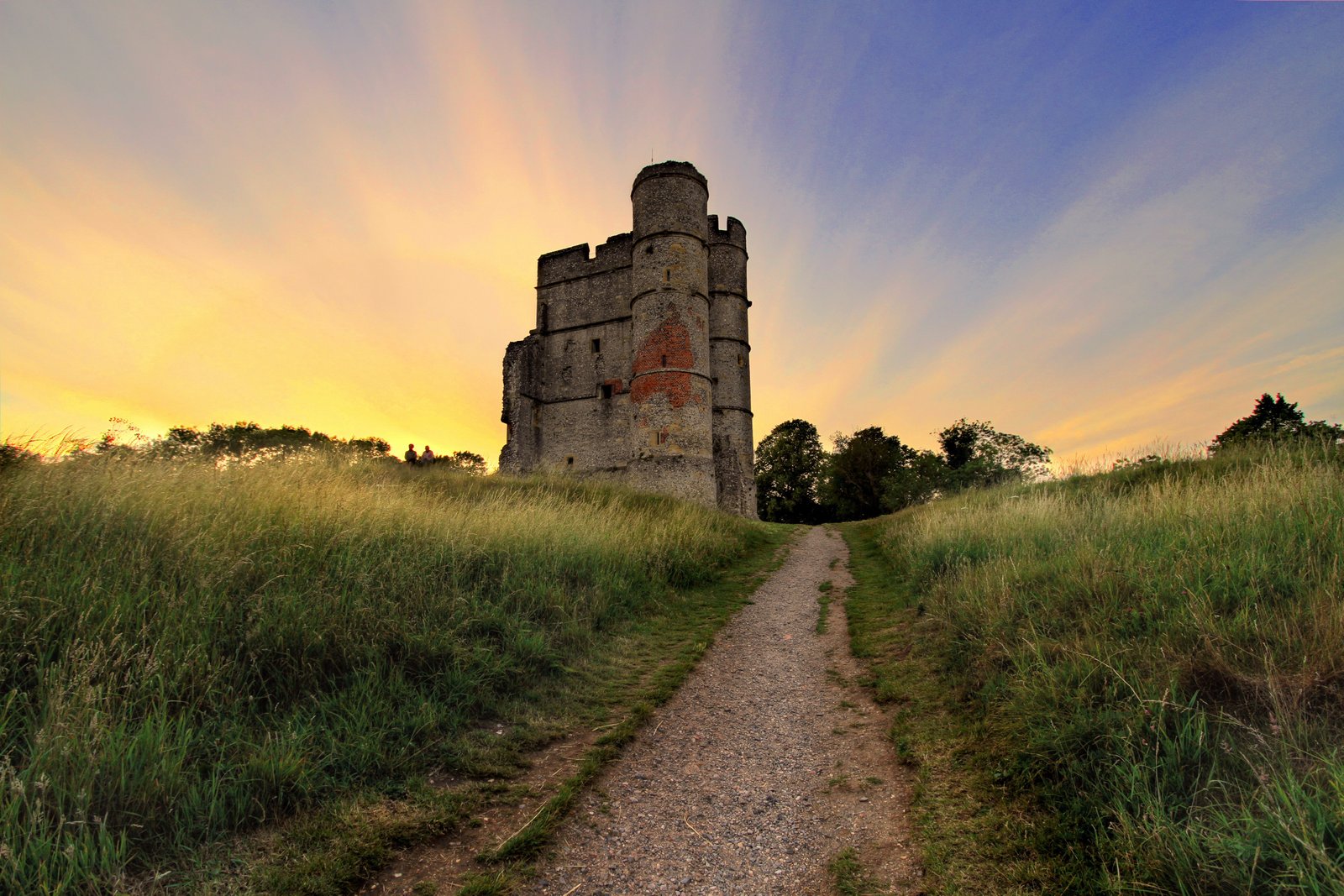
Donnington Castle is a ruined medieval castle, situated in the small village of Donnington, just north of the town of Newbury in the English county of Berkshire. It was founded by Sir Richard Abberbury the Elder in 1386 and was bought by Thomas Chaucer before the castle was taken under royal control during the Tudor period. During the First English Civil War the castle was held by the royalist Sir John Boys and withstood an 18-month siege; after the garrison eventually surrendered, Parliament voted to demolish Donnington Castle in 1646. Only the gatehouse survives. The site is a scheduled monument under the care of English Heritage.
History
The manor of Donnington had been owned by the Abberbury family since 1292, Donnington Castle was built by its original owner, Sir Richard Abberbury the Elder, under a licence granted by Richard II in 1386. The surviving castle gatehouse dates from this time. In 1398, the castle was sold to Thomas Chaucer, son of the poet Geoffrey Chaucer, as a residence for his daughter Alice, who later became Duchess of Suffolk. The Duke of Suffolk William De La Pole made Donnington his occasional residence, and considerably enlarged the buildings.
This family later fell out with the Tudor monarchs, and the castle became a royal property.[4] In 1514 it was given to Charles Brandon, 1st Duke of Suffolk. Though Brandon appears to have stayed at the Donnington Castle in 1516, by the time the castle and manor returned to the Crown in 1535 the structure was in a state of decay. King Henry VIII, Edward VI, and Queen Elizabeth I visited Donnington Castle, in 1539, 1552, and 1568 respectively.
In 1590 Elizabeth I granted keepership to Elizabeth Cooke (Lady Russell), the first woman to hold such a title in England.[7] In 1600, Elizabeth I gave the castle and surrounding manor to Charles Howard, 1st Earl of Nottingham.[5] Howard took possession in September 1603 and Russell disputed his rights.[8] By the time the English Civil War broke out in 1643, the castle was owned by the Parliamentarian John Packer family but after the First Battle of Newbury[9] it was taken for the King, Charles I, and held by Sir John Boys. They quickly enhanced the castle’s defences by adding earthworks in a star shape to provide gun emplacements.[4] Parliamentarians laid siege to the castle in October 1644 and the garrison held out for 18 months. With permission from the king, Boys surrendered the castle in April 1646 and was allowed to leave with all his men.
In 1646 Parliament voted to demolish the castle; only the gatehouse was left standing though the 17th-century earthworks can still be seen. The castle is now in the care of English Heritage and is a scheduled ancient monument number 1007926.
The castle stayed in the Packer family until the mid 18th century, when Robert Packer married Mary Winchcombe, and the property passed into the Winchcombe family tree. From 1833 to 1881 the manor and castle was owned by Winchcombe Henry Howard Hartley,
Layout
Donnington Castle was originally built in a roughly rectangular form, though the west facade projected outwards irregularly.[5] It was enclosed by a curtain wall, with a round tower at each of the four corners. Roughly halfway along the two walls running from west to east were two square towers. The courtyard enclosed by the curtain walls would probably have contained a hall, kitchens, and accommodation for guests.[4] Measured from the inner sides of the curtain walls, the courtyard measured 67 feet (20 m) north to south and 108 ft (33 m) east to west.[5]
During the Civil War star-shaped defences were built around the castle to facilitate gun emplacements. Only the gatehouse, crested by battlements, survived the castle’s destruction in 1646;[4] standing three storeys high, it measures 17.5 by 11.75 feet (5.33 by 3.58 m) internally.[5] Modern walls standing 0.5 metres (1 ft 8 in) high outline the original layout of the demolished castle. The star-shaped earthworks added during the Civil War are still visible, surviving to a height of 1.7 m (5 ft 7 in).[4]
Castle Occupants
Donnington Castle’s close association with the English monarchy dates back to its construction under a license granted by Richard II to the Adderbury family. Although the castle changed hands several times, it eventually became the property of the royal family, and consequently, many notable figures closely linked to the English monarchy visited Donnington.
Among the most prominent residents of Donnington were Sir Richard Abberbury the Elder, the original owner of the castle and Chamberlain to Anne of Bohemia; Alice Chaucer, Duchess of Suffolk; William de la Pole, 1st Duke of Suffolk; Charles Brandon, 1st Duke of Suffolk and 1st Viscount Lisle; King Henry VIII; King Edward VI; Queen Elizabeth I; Elizabeth Cooke, Lady Russell; Charles Howard, 1st Earl of Nottingham; John Packer, Parliamentarian, and secretary to George Villiers, Duke of Buckingham; Sir John Boys, the Royalist Governor of Donnington Castle; and Robert Packer, a politician and Member of Parliament. [10]

Portchester Castle is a medieval fortress that was developed within the walls of the Roman Saxon Shore fort of Portus Adurni at Portchester, to the east of Fareham in Hampshire. The keep was probably built in the late 11th century as a baronial castle and Portchester was taken under royal control in 1154. The monarchy ... Portchester Castle
Raglan Castle is a late medieval castle located just north of the village of Raglan in the county of Monmouthshire in south east Wales.
Caernarfon Castle is a medieval fortress in Gwynedd, north-west Wales.
Framlingham Castle is a castle in the market town of Framlingham, Suffolk, England. An early motte and bailey or ringwork Norman castle was built on the Framlingham site by 1148, but this was destroyed (slighted) by Henry II of England in the aftermath of the Revolt of 1173–1174. Its replacement, constructed by Roger Bigod, the ... Framlingham Castle
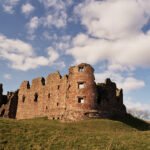
Brough Castle is a ruined castle in the village of Brough, Cumbria, England. The castle was built by William Rufus around 1092 within the old Roman fort of Verterae to protect a key route through the Pennine Mountains. The initial motte and bailey castle was attacked and destroyed by the Scots in 1174 during the ... Brough Castle
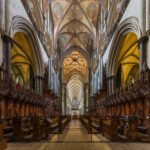
Salisbury Cathedral is an Anglican cathedral in the city of Salisbury, England.

Sutton Court is an English house remodelled by Thomas Henry Wyatt in the 1850s from a manor house built in the 15th and 16th centuries around a 14th-century fortified pele tower and surrounding buildings. The house has been designated as Grade II* listed building. The house is at Stowey in the Chew Valley in an ... Sutton Court
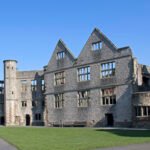
Dudley Castle is a ruined fortification in the town of Dudley, West Midlands, England. Originally, a wooden motte and bailey castle built soon after the Norman Conquest, it was rebuilt as a stone fortification during the twelfth century but subsequently demolished on the orders of Henry II of England. The rebuilding of the castle took ... Dudley Castle