Carlow Castle
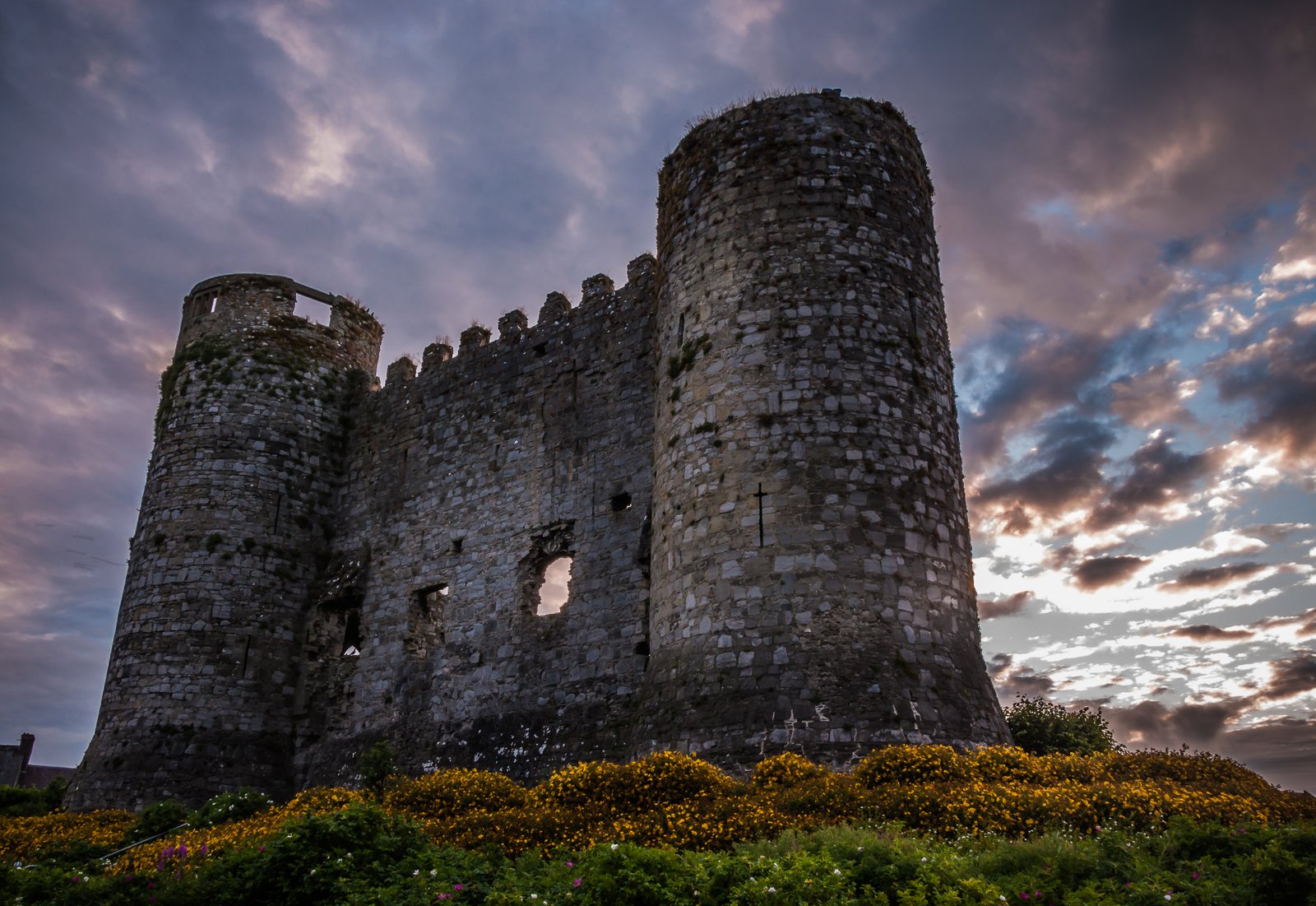
Carlow Castle (Irish: Caisleán Cheatharlach) is located near the River Barrow in County Carlow, Ireland. It was built between 1207 and 1213, and is a National Monument of Ireland.
History and Architecture
The earliest written record of this castle is from 1231 but it does not name its builder. It is widely assumed that the castle was built by William Marshal the elder in the time period between 1207 and 1213 which he spent in Ireland.[4][5][6] The castle in Carlow was the very first of its kind in Ireland, a towered keep, where a huge rectangular tower is surrounded by four smaller three-quarter-circular towers at the corners of the rectangle.[4][5] However, there have been doubts that the castle in Carlow supported the traditional function of a keep, i.e. to serve as a refuge of last resort. Instead it deliberately diverted from the contemporary standard in England and continental Europe, i.e. there is no towered curtain, no gate house, and no undivided great hall.[7] Similar castles of the same period were erected in Ferns, Lea, and Terryglass.[7]
The inner castle measured 16 by 9.2 metres (52 ft × 30 ft),[8] the towers had a diameter of 15 feet (4.6 m), and the walls were 9 feet (2.7 m) thick.[4] The inner castle had three storeys and timber was used for the upper storeys. The long west wall provided stairways[9] and two latrines. The latter indicates that the space was divided.[10] The entrance door was in the first floor but is now broken out.[9][11]
The castle was handed over to the crown in 1306, granted in 1312 to Thomas Plantagenet, confiscated by the crown in 1537 as the landlords were absent, bought by the Earl of Thomond in 1616, changed hands multiple times until it was taken by Oliver Cromwell in 1650 but was later returned to the Earl of Thomond. In 1814 the castle was widely destroyed in an attempt to create more space for the conversion into a lunatic asylum with the help of explosives.[6] Just the outer face of the west wall and the two neighbouring towers could be preserved.[11][12]
Codnor Castle is a ruined 13th-century castle in Derbyshire, England. The land around Codnor came under the jurisdiction of William Peverel after the Norman conquest. The building is registered as a Scheduled Ancient Monument a Grade II Listed Building and is officially a Building at Risk. History William Peverel The castle is a stone keep ... Codnor Castle
Lincoln Cathedral is a Church of England cathedral in Lincoln, England.

Sutton Court is an English house remodelled by Thomas Henry Wyatt in the 1850s from a manor house built in the 15th and 16th centuries around a 14th-century fortified pele tower and surrounding buildings. The house has been designated as Grade II* listed building. The house is at Stowey in the Chew Valley in an ... Sutton Court
Salisbury Cathedral is an Anglican cathedral in the city of Salisbury, England.
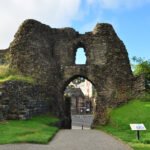
Brougham Castle is a medieval building about 2 miles (3.2 km) south-east of Penrith, Cumbria, England.

Trim Castle is a castle on the south bank of the River Boyne in Trim, County Meath, Ireland, with an area of 30,000 m2.

Portchester Castle is a medieval fortress that was developed within the walls of the Roman Saxon Shore fort of Portus Adurni at Portchester, to the east of Fareham in Hampshire. The keep was probably built in the late 11th century as a baronial castle and Portchester was taken under royal control in 1154. The monarchy ... Portchester Castle
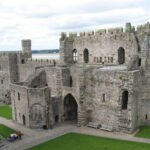
Caernarfon Castle is a medieval fortress in Gwynedd, north-west Wales.