Codnor Castle

Codnor Castle is a ruined 13th-century castle in Derbyshire, England. The land around Codnor came under the jurisdiction of William Peverel after the Norman conquest. The building is registered as a Scheduled Ancient Monument a Grade II Listed Building and is officially a Building at Risk.
History
William Peverel
The castle is a stone keep and bailey fortress, and was established by William Peverel. The present fragmentary remains represent a three-storey keep and a strong curtain wall and ditch, flanked by round towers. The outer bailey is on a lower level, and was constructed at a later period. The castle overlooks the Erewash valley and the counties of Derbyshire and Nottinghamshire. It originally had a deep moat, and on its eastern side, there was once a considerable abundance of trees, which have now been cut down. On the west side, there was a courtyard that was strongly fortified by huge round towers, which had battlements. In other parts of the ruins, there is evidence that the outer walls had arrow-loops included to allow bowmen to use them if necessary.
Henry de Grey
By 1211, it was owned by Henry de Grey, a descendant of the Norman knight Anchetil de Greye. Henry’s descendants include the long line of Lords Grey of Codnor, the Lords Grey of Ruthyn, Wilton and Rotherfield, Lady Jane Grey and the Earls of Stamford, and the extinct families of the Dukes of Suffolk and Kent. His son Richard settled in Codnor and was a loyal Baron to Henry III. Along with his brother John, they served the King in the Holy Land. John Grey distinguished himself in the Scottish wars, and found himself in great favour with Edward III. Together with William D’Eincourt,[5] the Lord Grey commanded all the knights of Derbyshire and Nottinghamshire in case of an invasion. Henry, the last of the family, died during the reign of Henry VII without a legitimate heir. He left part of his lands to his illegitimate sons, Henry and Richard, and part to his widow, Katherine Stourton.
Zouche family
The remainder went to his aunt Elizabeth Grey, who in 1429 married Sir John Zouche, the youngest son of the fourth Baron Zouche of Harringworth. Sir John Zouche of Codnor was three times High Sheriff of Derbyshire. The castle remained in the hands of the Zouche family for two hundred years until they sold up and emigrated to Virginia in 1634.
Streynsham Master
Sir Streynsham Master, High Sheriff of Derbyshire, who bought the Codnor Castle estate in 1692, is reported as the last resident of the castle. He lived there until his death in 1724.
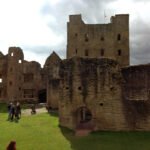
Ludlow Castle is a ruined medieval fortification in the town of the same name in the English county of Shropshire, standing on a promontory overlooking the River Teme. The castle was probably founded by Walter de Lacy after the Norman Conquest and was one of the first stone castles to be built in England. During ... Ludlow Castle
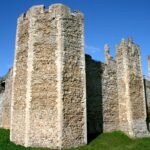
Framlingham Castle is a castle in the market town of Framlingham, Suffolk, England. An early motte and bailey or ringwork Norman castle was built on the Framlingham site by 1148, but this was destroyed (slighted) by Henry II of England in the aftermath of the Revolt of 1173–1174. Its replacement, constructed by Roger Bigod, the ... Framlingham Castle

Tynemouth Priory and Castle is a historic site located on a promontory at the mouth of the Tyne at Tynemouth. The medieval Benedictine priory was protected by walls, towers, and a gatehouse. The heraldry of the metropolitan borough of North Tyneside includes three crowns commemorating the three kings who have been buried in the priory. ... Tynemouth Priory and Castle

Nazareth is the largest city in the Northern District of Israel. In 2022 its population was 78,007. Known as “the Arab capital of Israel”, Nazareth serves as a cultural, political, religious, economic and commercial center for the Arab citizens of Israel. The inhabitants are predominantly Arab citizens of Israel, of whom 69% are Muslim and ... Nazareth

Carlow Castle is located near the River Barrow in County Carlow, Ireland.
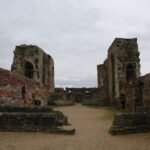
Stafford Castle is an ancient Grade II listed castle situated two miles west of the town of Stafford in Staffordshire, England. From the time of the Norman Conquest and as recorded in the Domesday Book of 1086 it was the seat of the powerful Anglo-Norman Stafford family (originally de Tosny, later via a female line ... Stafford Castle

Trim Castle is a castle on the south bank of the River Boyne in Trim, County Meath, Ireland, with an area of 30,000 m2.
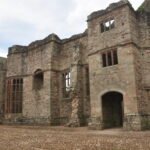
Raglan Castle is a late medieval castle located just north of the village of Raglan in the county of Monmouthshire in south east Wales.